

Transforming Government Review Operations with CACI’s AI-Powered HighVIEW System
CACI Case Study
Agencies today face increasing pressure to process, review, and release sensitive documents with greater accuracy and speed. Rising demands under the Freedom of Information Act (FOIA) and the Privacy Act, expanding classification requirements, and more complex mission environments are placing significant strain on traditional manual workflows.
Enter HighView: CACI’s proven enterprise content management platform, long trusted to support information management, case processing, and media exploitation missions across government agencies. Building on decades of expertise, CACI is advancing its HighVIEW platform with new artificial intelligence capabilities designed to modernize document review at scale. These AI enhancements introduce automation, consistency, and mission driven accuracy throughout every stage of the review lifecycle, enabling the intelligence community, federal agencies, and state government to significantly reduce turnaround times while strengthening security and compliance.
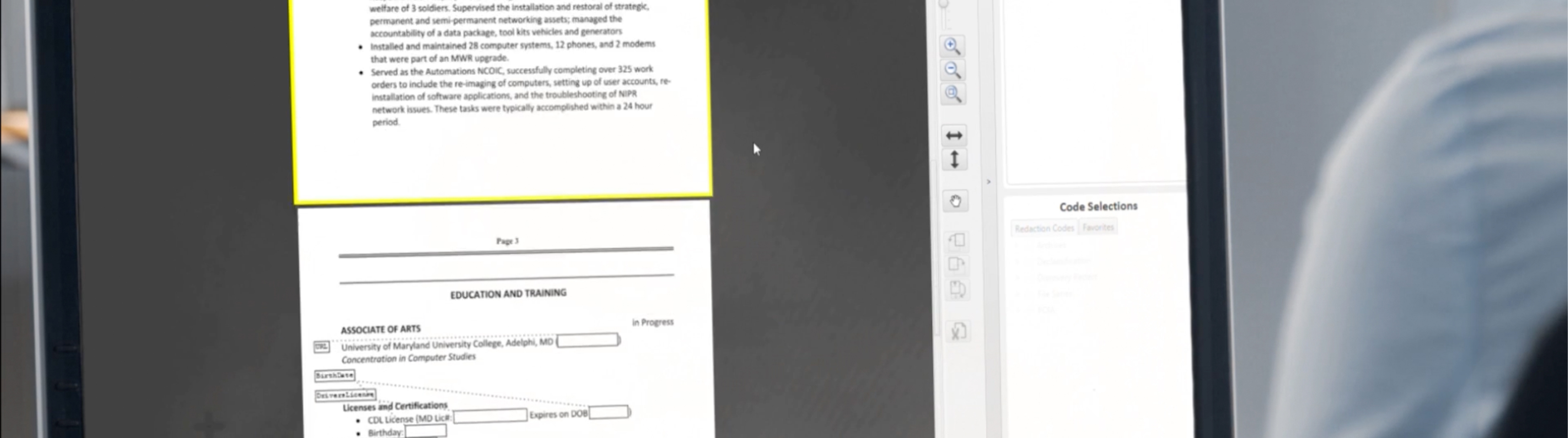
The growing burden of manual review
Personnel responsible for FOIA, Privacy Act, declassification, and disclosure workflows face a mounting set of operational obstacles. Manual redaction is both time intensive and error prone, often requiring analysts to review hundreds of pages line by line. Identifying personally identifiable information (PII) and classified material can vary significantly across reviewers, creating inconsistency and increasing compliance risk. Backlogs grow as duplicate requests, duplicate documents, and repetitive processing of previously reviewed content compound the workload. Even before redaction begins, analysts spend substantial time validating case requests, researching precedent, and locating related documents. As documents near release, analysts must prepare summaries and memos that further extend total processing time.
- Manual redaction consumes substantial analyst time
- Reviewer variability introduces compliance and security risk
- Backlogs accelerate as document volumes and duplicates accumulate
- Significant time required to assess and prepare cases before redaction
- Release summaries and documentation add additional processing burden
“These persistent challenges not only slow transparency efforts but also pull skilled personnel away from higher value mission work,” said CACI Vice President of Advanced Supply Chain Solutions J. Blair Parsons III. “Agencies need a solution that delivers reliable automation without compromising security, classification integrity, or essential human oversight.”

Smarter, faster review through AI‑driven support
CACI is enhancing its HighVIEW product with advanced AI capabilities to meet evolving agency demands. With these upgrades, HighVIEW will automate key steps across the document review lifecycle while keeping human oversight at the center. Using contextual AI, the system will more accurately identify sensitive personal and classified information, helping analysts quickly determine what requires redaction. It will detect duplicate requests and duplicate documents across large repositories, enabling agencies to eliminate redundant work and reuse prior redactions. HighVIEW will also validate incoming requests against agency rules, allowing analysts to focus their time on eligible cases that need expert attention.
During review, analysts will be able to use natural‑language prompts to locate sensitive content, receive real‑time redaction suggestions, and refine AI output through their decisions. When cases are ready for release, the system will automatically generate draft summaries to reduce administrative workload. Over time, HighVIEW will continually learn from analyst feedback, becoming more precise and more efficient with each document processed.
Estimated time savings
- 30–60 minutes saved per document through AI‑based PII redaction
- 60–120 minutes saved on initial classified‑content review
- 20–45 minutes saved on duplicates by applying prior redactions
- 5–10 minutes saved per identified duplicate requester
- Hours saved per case through automated comparison to prior releases
- 20–40 minutes saved per release memo via auto‑generated summaries
- 10–25 minutes saved on complex scenarios using natural‑language search
- 10–20 minutes saved per document with AI‑generated redaction suggestions
- 5–10% efficiency improvement per iteration as the AI learns

A modern, mission‑ready foundation
HighVIEW’s AI integration will be deployed in phases, starting with existing HighVIEW customers who process high FOIA volumes and can provide immediate, real world feedback. Insights from early adopters will shape refinements before broader rollout to additional agencies.
Future phases will introduce deeper AI capabilities, including enhanced classified content analysis through Retrieval Augmented Generation, improved handling of image heavy documents via vision language models, and mosaic effect detection to strengthen security across multi document releases.
“With each iteration, HighVIEW will deliver greater speed, accuracy, and operational impact – helping agencies shorten review cycles, improve consistency, and strengthen the security of every release. This evolution enables a truly modern, scalable, and mission-ready approach to government document management,” said Parsons.